

Listing the factors that contribute to a company’s success is no simple task. The ingredients for the perfect recipe vary from case to case. Vision, flexibility, adaptability to change, combined with passion and pragmatism, can certainly be counted among the essential elements.
A good question might concern the future. Imagining one’s business twenty years from now provides a fairly accurate idea of how the present is perceived: a final destination or a new starting point? Talking with Captain Rosario Trapanese, founder and current Director of New Development and Strategy at IMAT, clearly leans toward the latter.
The man who transformed the maritime training sector in Italy—introducing a sequence of innovations in organization, technology, and teaching—is already contemplating yet another revolution. After all, those who sailed with him in the past say he has always had a drive for change:
“When I decided to come ashore and embark on the training venture, I had a precise goal: to solve the many problems we faced on board,” he explains. “A clear vision that has evolved over time, adapted to changing contexts, but has always been pursued with determination and perseverance.”
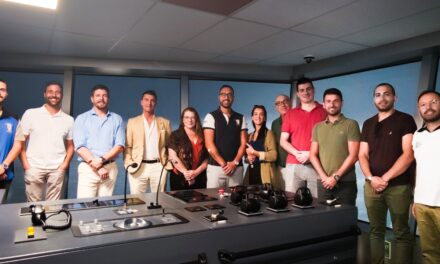
About twenty-five years have passed since that moment. After being the first to introduce the concept of a nautical college, establish contracts with major shipping companies, develop interactive simulation technology, and more recently, build a full-scale replica of a ship’s bridge, Trapanese now talks about “closing the circle.” The new vision is:
“An integrated service covering all aspects of training.”
How did this vision come about?
Let’s take a small step back. It starts with our tendency to closely observe changes in the shipping market.
As an internationally-oriented entity, still focused on Italian needs, we are witnessing a growing gap between the demand and supply of maritime personnel. Just look at the order book of new ship constructions over the next five years. From new cruise ships to ferries and cargo vessels, approximately 200,000 new seafarers will be needed. These are not small numbers to manage in such a short period—unless specific steps are taken to anticipate the issue.
What kind of steps?
We need to create a system. We must establish virtuous synergies between the world of education and training, based on a vision that goes beyond current sectoral boundaries. Unfortunately, this is a difficult goal to achieve.
Resources from the PNRR (Italy’s National Recovery and Resilience Plan) have been channeled into strengthening internal structures, making collaboration even more complicated. The idea of a joint venture between an MTO (Marine and Technical Operations) Academy like IMAT and an ITS or a maritime academy, for example to collaborate on hospitality and onboard services, seems increasingly unlikely.
Given this context of vision, growth, and future, we are considering the idea of closing the circle: recruiting, training, and manning. In other words, attracting people, training them, and providing them directly to shipping companies.
How do you plan to achieve this goal?
Our idea is to create a true campus. There are dozens of roles and departments to develop, each requiring tailored training for onboard positions.
A structure like this would above all allow for interaction between all members of a potential crew. Naturally, following our path of real-world training, the centerpiece would be a cruise ship built on land, with at least three decks, where all related course activities could take place.
What would the scale of this structure be?
Excluding the possibility of acquiring a decommissioned vessel—which would be hard to manage long-term—we are leaning toward building a land-based structure with the size and layout of a real cruise ship.
This would be the hub for training staff in housekeeping, dining, kitchen services, and more. Once they leave the campus, trainees would be fully ready for deployment, regardless of the commercial sector.
This approach would also help solve a growing issue related to onboard safety.
How?
The exponential increase in ships in service inevitably affects safety levels. It’s a mathematical fact: the risk of accidents grows with activity volume.
That’s why crews—essential to the cruise industry’s credibility—must be able to manage any emergency situation. The land-based ship would be equipped with a full range of lifesaving appliances, allowing evacuation drills in the most realistic environment possible.
We are trying to convince shipowners that investing in this new training model is a real strategic investment. It will take time, but we are confident they will follow us on this course.
Let’s go back to the shortage of seafarers. What’s causing it?
There’s a vocational crisis. The sea is no longer seen as a path to social advancement, as it was in the past. This is clearly due to material progress in our society.
Meanwhile, the nature of the seafarer’s job has also changed. Work periods on board are less strenuous than in the past. And the recurring claims about lack of protection seem exaggerated.
Thanks to IMAT’s partnerships with major national and international shipping groups, the cost of mandatory training has plummeted. Even the alleged high entry barriers no longer hold up. Instead, we should focus on raising awareness about the real opportunities—including financial—offered by this career.
So, where do you hope to be in twenty years?
I believe the campus will be fully operational and well-established by then, while IMAT’s operational structure will—as always—be working on new improvements and innovations to support the maritime industry of the mid-21st century.
What must remain unchanged compared to today is the quality of the personnel trained: from officers to the waiter serving at the table, each one must ensure top-level performance.
So, what determines a company’s success?
It’s one thing to have an idea or a vision; it’s another to put it into action.
Looking at what we’ve achieved so far, it has taken consistency, perseverance, and determination. Above all, passion for what we believe in, paired with the entrepreneurial pragmatism needed to turn vision into reality.
I’ve been supported by a team of collaborators who have always responded enthusiastically to the challenges of a constantly evolving sector.
In short, it’s about having ideas worth pursuing, while adapting to the moment, to the times, and to emerging needs. That’s what we’ve always done at IMAT—constantly reinvesting in human capital, new technologies, and the development of the right infrastructure.